Showing posts with label Evaluation. Show all posts

Tuesday, August 19, 2014

Powering my Quest for Yurt Love

How much electricity do I need to meet my basic needs?

I've looked at a lot of different housing alternatives from nylon tent to camper, and now yurt.  Watching my daily power usage, and more interestingly how I live when the hydro goes off, I think I have a fair idea of what I need to be comfortable.

Assume that water and heat are taken care of by other means, my electrical usage is really quite small.  

Lighting:

Given my druthers I have very few lights.  
  • Outside lighting: When I'm outside after sunset on the farm, I seldom use a flashlight.  The moon is tremendously bright most of the month, and when it's cloudy, the light reflecting from the city against the clouds is sufficient to do my chores.  It's only finite work (small hand generator flashlight) or hunting monsters (big meg light with batteries that last 6 to 10 months) that I really need outside light.  Though, I admit, I do like having an outside light hanging next to the front door to welcome me home after a midnight stroll.  
  • Inside lighting: I very seldom have lights on in the house when I'm home alone.  I like the dark not just because it's easy on the eyes but it hides me from any fictional monsters that might lurk in my closet.  There are however a few tasks in the house that one needs illuminated.  
    • Cooking: Any knife work needs good lighting, as well as cleaning up the dishes afterwards.  But the main cooking can be done in dim light as it's mostly taste, smell and texture.
    • Crafting: About 50/50 dim and strong light, depending on the craft.  Spinning, wool prep, some weaving... they can all manage with low light, but sewing, fancy weaving, spinning novelty yarn, &c. all need strong light... then again, I'm usually to tired to do the fancy work at night, so basically it's a day task
    • Reading and writing: This needs strong light, but it's another one of those tasks I do best during the day as my head clouds as the day progresses.
  • Entertainment: 
    • I watch TV because it is there, but if it wasn't...would I miss it?  I don't think so, not a lot anyway.  We have lived without cable before, in fact, the only reason we have it now is so the Ancient can watch Jeopardy.  Though I do like watching occasional videos.  When the electricity goes off for days on end, the only time I totally despair is when I miss Dr Who.  Everything else is Humdrum.  Assuming there will be a garden and livestock, I'll have plenty enough to do in a day without TV, and get more done without it snaring me with it's glow.
    • the only other thing would be my e-reader.  This needs charging once every 3 to 4 weeks, and takes about 2 hours to charge AC.  I think this is necessary because so many books have soy and other chemicals I'm sensitive to in their ink/paper, whereas the plastic (most) ereaders are made from is fairly stable (it doesn't off gas).  This greatly expands what I can read.
  • Music/Radio: This is the only true necessity for me.  Silence is painful and having music and/or radio is the only cure.  Though this may have improved since I last looked, I haven't seen a solar or wind up radio that lasts 12 hours of play time between charges.  So something with replaceable batteries, or rechargeable ones.
  • Electronics: computer?  As much as I enjoy the internet, I also find it frustrating and distracting.  I'm of two minds as to whether I want it in my future home or not.  Sometimes it's wonderful because I can look up information that I need urgently, or order books from the library.  I love blogging, but I worry that it's just adding to the clutter overload of the interweb.  And wading through that clutter when I need to find some useful information is a major time sinkhole.  There are also games that distract me.  Other electronics include camera - which would be used less with less blogging, and 
  • Communication: I'm an introvert in almost every meaning of the word.  I'm awkward with people and find I'm very insecure about interacting with others.  I can put on a show, pretending to be confident, but it's exhausting.  I could see myself content with very little human contact.  The problem is we need others.  Even in my hermit life, where I spend every day with my sheep, I still need others.  This may seem contradictory, but I love teaching skills to others.  My favourite thing I did this summer was to mentor a friend to start a vegetable garden - her very first garden.  Helped her turn the soil, showed her how to plant the seeds and from there, offered help when needed.  I've spent most of my life gathering skills like gardening, spinning, sewing, cooking, fermenting... all completely irrelevant in the modern world.  However, I wonder... in the future, these might be the very skills people need.  What if global transpiration breaks down and we rely entirely on local food supplies?  Every lawn will be dug and replaced with potatoes, beans, grains... Like they were in England during The Great War.  How many people can make a four foot by 5 yard bit of dirt produce 4 crops a year and feed 6 people all the veggies they need?  I can.  Maybe in the future, other people would like to too?
    • So I guess I do need some form of communication with others.  A land line is simplest, but requires hook up to the grid.  Probably a basic cellphone like I have now - my phone makes phone calls and nothing else.  Costs a fair bit for someone who uses 4 minutes a month, but if it was my only phone line, it might be up to 10 min a month.  I've tried pay-as-you-go in the past and found it beyond my capacity to keep up with.
    • Also, internet.  I feel weird not having any at all.  I can always travel to the local library and use the wi-fi, but that's a pain and people expect instant email response these days.  Maybe a basic wireless system that I can hook up to my laptop just for simple things like reading, emails, forums... that's about all I would want.  Something slow enough that I don't feel compelled to use it hourly.  
Laptop, phone, ereader, some lighting, radio, perhaps a fan in the summer, and... I can't think of anything else.  But there will always be something else that comes up.  I'm thinking that if I calculate the absolute maximum I think I'll ever need and double it... things should be golden.  

For those of you who craft, you may wonder why I'm not including the sewing machine.  The truth is, I don't get on well with electric ones.  All my sewing is either by hand crank or treadle, so why would I want to convert to electric?

And a clock... Well, I have a beautiful clock that winds up with a key.  It lasts about 8 days between winding.  No electricity needed there either.


How to power my yurt?  I want to be as independent and off grid as possible, so solar, wind, water... all these are possible ways of producing my own power.  A small wind generator may only produce a tiny trickle, but it adds up over time.  Water... well that depends on proximity to a stream or other flowing water, but can be quite powerful.  Solar would have to be my main source.  Which is convenient because I just happened across a system that would be perfect:  Goal Zero Yeti 150 Solar Generator Kit has both solar panels and battery/controler thing.  At the time of writing, it's $400 plus shipping, customs, duty, exchange rate...except, apparently there are shops nearby that sell this company's products, so a bit of research is needed.  Based on previous orders from the US, I'm assuming that shipping and customs will total $200, so a total estimate of $600 for a simple solar power system for my yurt.

If it was just me living in the yurt, that system would be ample.  However, with friends and/or family, we would need something greater.  

Not anywhere near ready to order a system yet, so I'll keep researching and if I find something that else that catches my fancy, I'll let you know.


Wednesday, July 30, 2014

Better calculating the wall and door costs

My last post was a bit despondent.  Now I've had time to reflect on things, I don't think that the dream has ended just yet.  I just need to plan smarter that's all.  There is a lot I can get started on my own and once I've made a move towards my goal, I just have to trust that something or someone will happen when I need it the most.

I'm also thinking that a yurt will be very handy for teaching.  I'm amazed to discover that people are interested in learning some of the things I do regularly here on the farm, even cooking related things.  There have been requests for lessons.  The problem is, I don't have a proper space to teach any of it.  Maybe the yurt will serve as a teaching space.  I would really like that.


When it comes to spatial thinking, I'm pretty useless.  Translating a bunch of measurements into an image of what it will actually look and feel like - and the other way around - is a challenge.  To compensate for this, I got out the sidewalk chalk and did some life size drawings of what the yurt wall needs to be like.


This has given me a much better idea of what the lattice needs to be.  I estimate that if the laths are 8 foot long and closer spaced together, I can use thinner bits of wood - like a 2x4 sliced in 4 lengths.  Note, a 2x4 may claim to be two inches by four inches, but in reality it's significantly smaller than that.

I calculate that I need a little under 100 laths to make the wall section.  That's 25, 2x4s which comes in at a little under $100 for the lot (after tax and stuff) plus a blade to rip them with.  Assume the rawhide for joins will be made with materials here on the farm, that gives us $150 total for the wall, or $1.50 per lath.  This is a hundred dollars less than my original estimate.  Amazing what a little sidewalk chalk can do to make the day more cheerful.


Now the door - very intimidating part of the project for me.  But then I saw to my surprise that the ramp to the chicken house we took down last week is actually a well weathered solid wood door.  Perfect!  It's even got that panel look to it I was hoping for.


It's in major need of love, but I can manage taking it apart, cleaning it up, putting it back together and painting it TARDIS blue.  It will have to be upside down (the way it is in the photo) and I think I would take out the other two panels from the 'top' of the door and replace all three with something to let in the light.  I also like the idea of making it a Dutch door by cutting out the center part and having a top and bottom section.  This will also make the door just the right size at 5 foot high.  Add the door frame in, and we will be just about the same height I estimate for the walls.

I still need to buy the frame, hinges, handles, latches, locks, primer, paint, sandpaper, &c.  I don't know how much any of that costs, but I know a great salvage shop that has a basement full of that kind of stuff (excepting the frame, I'll have to make that).  I have no idea how much that will costs, but I'm guessing a lot less than my original estimate.  For now, I'll say $200 for the door and door frame.

So, yes, the door itself will be a lot of work, but it's something I can get started on right away.  An actual physical action I can take in the real world towards acquiring yurt love.  This makes me hopeful.

Update: I've upped the wall estimate back to $250 after doing more shopping around.  Hopefully it won't be anywhere near that much, but we'll see.

Monday, July 28, 2014

Budgeting the Yurt - is this the end of the dream?

I've had a look at how much it will cost to make a 16' yurt.  I estimate that the frame, roof, felt, canvas, and door will come in at about $2,300 CDN to make from scratch.  I hate to admit this, but a number that large is unobtainable for a person like me.

I haven't even begun to calculate flooring, finish for the wood, and furniture for the yurt.  Or if/how I will power it.  Plumbing... 

Doing the work is fine, it's basically a bunch of repetitive tasks; measuring, cutting, drilling, sewing, &c.  Though there are a few skills I don't have yet like how to make the hub and door.  But they can't be that difficult to learn... can they?

It's the material cost that has me stumped.  I look at this estimate and look at all that isn't included and I despair.  


Sure it's a good deal less than buying a new yurt.  I calculated a beautiful Mongolian 16' yurt, with basic furnishings, delivery, flooring, tax, &c. would cost roughly $25,000.  More than 10 times more than my guestimate for a DIY yurt.  This should make me feel better because a home build yurt will be so much less, but it doesn't.  


The time has come to evaluate whether or not a yurt is in my future.  I have good reasons to want a yurt, not just for future security but also as a sanity sanctuary.  There is also an overpowering desire for a simpler life that yurt living brings.  It is my dream, and I feel that I need to make it happen.  If not this year, then the year after... or the one after that.


When I estimated the cost of building a yurt, I did round up some numbers.  There is always things that one forgets to include, and the price of things has a habit of increasing.  But I also assumed I would have to purchase the materials.  Maybe I can find materials, either in nature or salvage them from discarded items.  This would make the financial cost more manageable.  

What I'm toying with is the idea that I budget $2,500 for making the yurt.  If I can save money on materials, for example finding wood that could be used to make a door instead of buying one, then I can take the money saved on the door and apply it to the floor, or furniture... So even though it would costs far more than $2,500 to buy the materials, maybe with a bit lot of creativity, it can be made for less.

But to find the money, the skills, the people... this means asking for help.  How is it making me independent if I need help to get there?  What could I possibly have to give back to people to thank them?

I think I could never ask... But I also know if someone asked me, and it was something I could do, I would help.

Then I think about crowdfunding... Some of the campaigns online seem so frivolous, and yet people have money to give, and they give it.  Is building a home anymore frivolous than making potato salad?


I don't think I have what it takes to run a crowdfunding campaign - I barely ever answer my emails, how can I pretend I would be any good at social media.  I blog as release, not because I expect people will ever read it.  With social media, we come to yet another skill and another area I need help with.  It's never ending.


Or maybe it is ending.  Maybe my yurt dream ends here.
I have a lot to think about.

Saturday, July 26, 2014

Planning the Yurt Door

To begin with, one door should suffice.  The beauty of a yurt is that you can add doors and windows as needed.  So plan to make more in the future, but for now, just one.


Perhaps my most important qualification for a yurt door is TARDIS Blue.  It doesn't necessarily have to be TARDIS shaped door, but something like this looks lovely in blue.  Maybe with windows at the top to let some light in, maybe not.


I would also like my door to be what they call a Dutch or Barn door.  What I call, a door in two parts where you can open the top, the bottom, or both.  Something like this, only perhaps with the door swinging out and a bug screen on the inside.


How to build the door and frame?  Time to go back to The Library.

Looking at traditional yurts, one can see all manner of doors.  Some a simple frame with a heavy drape of felt covering the entrance, to heavy duty wooden doors.  Felt makes a lighter and less fragile door for travel, but it is also less secure against raccoons and other monsters.

Going back to: The House that Jack Built; Circle Houses; Yurts, Tipis and Benders by David Pearson,  an inspirational book with a small bit of how-to hidden at the back.  It's such a small section about the door, which basically says we can make a Kyrgyz-style door frame with four posts that slot together - this is the type of door that works well with canvas or felt.  Alternatively a Mongolian-style door is "fixed to a solid frame, this can be a single or double and looks wonderful when carved and painted."  From looking at the photos, it's the frame that is single or double.  I like double best.

Or maybe it is the door after all that is double?  Bumming arround the internet I keep seeing doors like this:


There is a solid outer door, and then two inner doors with windows (sometimes with glass, sometimes some other way to let in the light).


I wonder if this would be more difficult to make than a Dutch door.  Three sections instead of two makes it seem harder to the untrained eye - but then again, depending on what materials I use, it might be easier.

The book Tipis & Yurts; Authentic Designs for Circular Shelters by Blue Evening Star has some very specific instructions on building a door and door frame.  In this book, the door is canvas covered framework.  It would be quite nice as a summer door but I wonder how well it would stand up to our wet winters here.  Remember, this book has a blend of Western technology and Traditional Mongolian inspiration for the yurt design.

The door frame is very complicated to me with extra braces made from plywood and a great many screws.  The advantages of this kind of door frame is that it would be quite stable, the disadvantages is that it doesn't seem overly portable.  It also seems to take a lot of wood.

Most other resources gloss over the door building element.  Basically, there isn't a lot of info about building a yurt door in print format, so it's off to my old friend Google.

Some yurts have regular house doors, others doors much larger than the walls of the yurt.  Neither appeals to me.  Although... a house door already in a frame could be adapted to fit a yurt, so long as it is solid and can be cut down to size... then again, that would also be a heavier door than needed and not necessarily separated into two parts.


Basically google has lots of lovely images of yurt doors but precious few details on how to make them.  So I guess it's such an obvious thing that everyone in the world already knows how to make yurt doors from scratch that they don't need to write about it in books or websites... ?


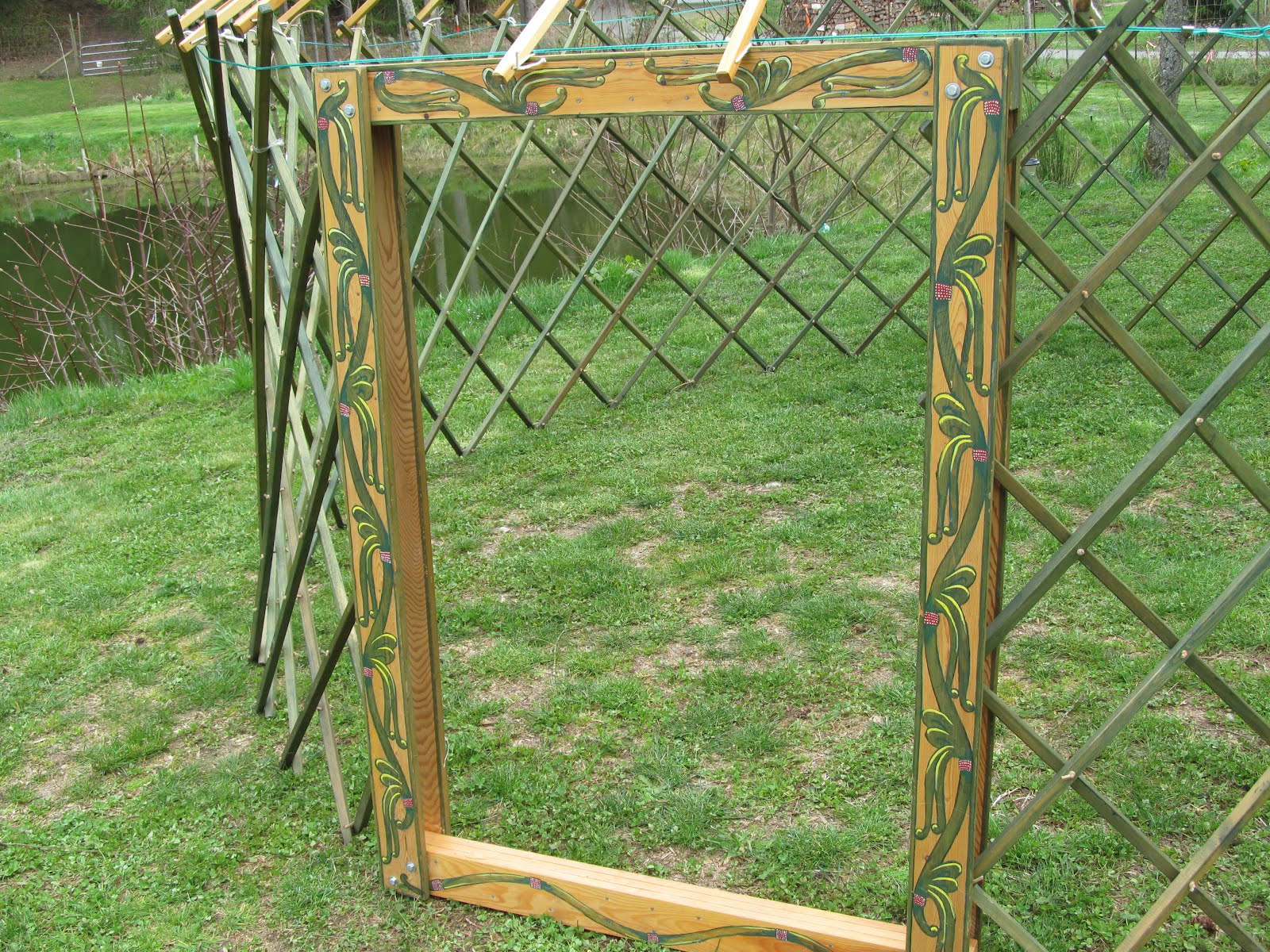
This is the door frame of OB1's yurt.


What I like best about it is that the lattice fits inside the frame - the uprights have two walls... how to explain... maybe the threshold and the top of the frame are 2x4s and there are 4 uprights, two on each side, maybe 1x4s.  The uprights attach to either side of the horizontals so that there is a gap between the uprights that the lattice can fit in between the uprights... my words are making things confusing, but maybe you can get the idea from the photo.

Another good thing about this door frame is that it folds up nicely.  When erected, each corner of the frame has two bolts, but take one bolt each from each corner and it can collapse for easy transport and storage as you can see at the top of the next photo.


The biggest problem with having a wooden door on a collapsible frame is that it would need to be rehung each time we move the yurt.

The Yurt Workshop people have some interesting things to say about the difference between a house door and a yurt door:

A yurt door is unlike a conventional house door, yurts generate stresses in the opposite direction to those on a conventional door frame, and this needs to be understood if the door is to be made correctly. After studying the yurts and the craftsman from Mongolia and Central Asia we implement their understanding and craftsmanship into our doors and door frames. The best pines are selected and we use traditional mortice and tenon joints, secured with the traditional wooden pegs, and in addition, for added protection we use boat makers glue to make sure the joints are sealed and they give many years of trouble free life. So, no matter what design you choose, you can be reassured of a quality and attractive door for your yurt., 


Woodland Yurts, a UK company has my favourite door of them all, even if it isn't TARDIS blue.  If I had a door like this, I think I could survive without painting it.


It's made from oak and they call it a stable door.  Heavy, but strong and beautiful.  Maybe something similar can be made from reclaimed wood, only without the curved top - now, where to find the wood?


What skills do I need to make a door and frame for my yurt?


  • evaluate and choose appropriate wood
  • recondition or reclaim old wood (if I can find any suitable)
  • Construct a sturdy frame
  • Construct a sturdy door
  • Hang the door (attach hinges in the right place, and stuff)
  • Cut wood to right size
  • probably drill holes for lock and stuff
  • attach hardware
That's a lot of skills to learn for this project.  A lot of skills I don't have yet.  


How much to budget for the door?

Most yurt companies doors start at about $450, and quickly go up from there.  I don't think making my own door will be that much... at least not for material cost.

Although I plan to use reclaimed material where I can, I'm going to assume the worst and price it out like I'm buying the materials.  Better to overestimate the cost that way when things come out cheaper, one can be pleasantly surprised.  Also, any extra money left over can be used to host a yurt party for everyone who helped.

So I'm going to budget $450 for the door - because if I can't learn how to build one myself, that is the lowest price I can find for a pre-made yurt door.


Update: I found a door that may be salvageable, so estimate for the door and doorframe is now at about $200.

Wednesday, July 16, 2014

Why did I fall in love with Groovy Yurts?

When I first found Groovy Yurt's website, it was one of those life changing moments.  Seeing the yurts for the first time kindled a small fire in my heart, and it's burned there for several years now, very steady, slowly increasing.  This flame is the knowledge that one day I will live in a yurt.  I don't know why or how I know this, but I do.  The feeling is bright enough now that I know it's time to act.


What was it specifically about their yurts that captured my attention?

First of all, I think of independence.  It's not just a structure, or a fancy tent, but rather, it is a home.  A home that can travel with me if I ever need to move.  Even if I don't move into it right away, I can feel secure it will be there for me.

Then there is the exotic element of these particular yurts.  Go and have a peek about their sight.  Look at the beautiful shape of them.  Look at the hand painted wood.  These yurts are true works of art.

I like the shape of these yurts.  They look low and gentle, like they are hugging the earth.  A lot of more modern yurts are too upright.

These yurts are constructed with natural materials using traditional methods.  Cotton canvas, layers of felt, wood, and leather.

Matching furniture.

If I had my druthers, I would love to have their four wall yurt.

Then again, the more I think about making my own, the more I enjoy the dream of having it match my style.  Little details like having one of those doors that is split in half horizontally.  I think it's called a paddock door.   Now that would be a must for me.  A blue one.

The quest for yurt love

I love yurts.  The idea of something so stable, yet temporary and portable.  


The goal of this blog is to encourage myself to build a yurt.  As an investment in the future, my future, I think a yurt is the structure for me.  Certainly, I live in a house now, but one day my situation will change and instead of seeing things as being hopeless, if I have a yurt, I will always have a home.  A place that is mine during hard times.  A strong home, yet temporary - as in to remind myself that troubles are temporary and things will come around again.

The first picture is from Groovy Yurts.  They specialize in imported Mongolian yurts, and when I came across their website years ago, my heart leaped.  How could a tent, nay, a home, be so beautiful?  It was then that I made the resolve that a yurt would be mine.

Over the years, I took the opportunity to get to know some other yurts.  Here's one in a park that people can stay in.  


The construction style is yurt style, mostly, but it's a very modern version.  It has a thin, plastic wall that resembles a tent more than a home.  What I liked most about it is that it kept the wind out, had extra light from the windows and is built on a raised floor.  The elements I didn't like were that it was too tall at the walls, so it didn't keep much heat where one needs it at night.  On top of that, the plastic-fabric didn't breath, so the air inside was stale.  It was hot and stuffy during the day, and cold and clammy at night.


Here's some photos of my friend's yurt.  We set it up in the backyard and I stayed in it for about a week while we painted the house.  I do poorly with certain chemicals, specifically ones made from soy and petroleum, so I need to avoid paint while it offs gass.  But after a week or two, I can go back in the house.


I hesitate to call this homemade because the wooden structure was made by someone with a small cottage industry of making yurts for friends.  The heavy cotton canvas was sewn by the owner.  It's a beautiful yurt.

The wooden walls are about 4 foot high and the centre maybe 8 or 9 feet.  Excepting the door, all the joints are tied with leather cordage or cotton string.   The interior of the yurt was more comfortable than the park cabin version because the natural fabric allowed the air to flow slightly through it.  So it was fairly cool in the daytime, and not terribly cold at night.

The yurt was about 10 foot across, and I found it just right for temporary dwelling, but I really would want something larger if I were to stay there for any serious length of time.

The only thing I didn't like about this particular yurt was the walls didn't reach all the way to the floor, so there was a gap at the bottom that raccoons and wind could get in.


With this small amount of experience under my belt, I am convinced more than ever that I wish to live in a yurt.  I have a general feel for what I want from a yurt, though I imagine that will change as I progress on this project.  

I very much want the mongolian style, with felt walls and perhaps a canvas cover for winter.  Natural ingredients are a must.  Reclaimed and local materials are prefered.  Though I don't have the skills yet, I wish to make each part myself - or at least help someone else make the parts I can't do on my own.  I seek enough room for sleeping, cooking (even if it's just a fire pit), storing food, daily necessities, and if possible my spinning wheel and loom.  

It's an awfully big project.  I worry, an expensive one.  If the beautiful mongolian yurts cost several grand, how much would it take to make my own at home?  At the moment I have $20 and enthusiasm.  It's not enough.

I wonder... though I hate to ask for help, I don't think I could do this alone.  Maybe if I price this out, and ask the internet, maybe I could find some people with skills and spare change to help fund and assist with my dream?  I know there is great kindness on the internet, but is this a worthwhile cause?  What could I do to make it less selfish?  What could I offer the global community?  

Posting my experiences, success and failure is a start.  But I would record these anyway.  

What skills do I have that I can exchange?  About all I'm good at is back to the land skills.  Textiles, growing things, cooking in unusual situations and making full use of all ingredients.  I don't like to beg, so maybe there is something I can make to say thank you to kind strangers.  

These are my major obstacles: funding and finding people willing to share their time and skills to teach me how to do the bits I don't know how.