I've been having a lot of dreams lately about yurts. There are three or four different dreams, that have been repeating themselves almost every night for the last two months. Perhaps my subconscious is trying to yell something at me.
These different dreams share a similar theme, they all address food security issues.
For example, one dream occurs in the near future. There has been a breakdown in the long distance food supply for some reason. Lack of fuel, major strike, political unrest, all or none of the above, I don't know. Dream doesn't say why. But it happened and it didn't happen yesterday. It's been several months, approaching a year without the major industrial food supply and people are slowly starving. There is an intense interest in Victory Gardens (small home garden plots where once there was emerald green lawn). But what does all this have to do with a yurt?
In this dream, some philanthropist has hired me to give free lessons to the community on how to harvest, process, dry and store seeds, which I give in my yurt. Yurt is awesome for this because the walls can be adjusted to let more or less air in, depending on the weather.
Another yurt dream involves a time when it has become illegal to grow or even cook your own foods. 3D printed soy and corn based meals are considered the only 'safe' alternative, for some reason. Maybe the bees finally bit the dust, or some major food safety scare, or whatever. But it's considered not only illegal but impossible to grown your own vegetables. Yet, here I am, living off-grid in my yurt, blissfully unaware of this known fact, that it is impossible, and have a lush garden filled with tasty things from grain to flax, to mangel wurzels for my goat.
The third yurt dream that really stands out is one where I live where I do now, have the garden I have now, save seeds, raise sheep, grow and cook my own foods, all things I do know. Only difference is that I have a yurt. A lovely large-ish yurt. In this yurt I host small tutorials on how to do everything from plant seeds, to ferment wine, to bread baking, to miso club gatherings, to curing and smoking meat.
This dream is my favourite because it could be possible.
Maybe that's the motivation I need to make this yurt happen. Maybe it needs to be less about me, and more about teaching self sufficiency. That is what a yurt symbolizes to me, self sufficiency - and to use the yurt for teaching those skills to others. Now that would be wonderful.
I have the skills to teach, and the love of sharing what I know with others. The act of getting my arse in gear and organizing actual events - and getting the word out - that is my major shortcoming. But here's motivation to remedy that.
But then again, I need a yurt first... catch 22.
How can I use these dreams to inspire me? One of the biggest obstacles to having my own yurt is funding. Why not take the idea of food sustainability and monetize it slightly? I can sell seeds!
Yurt Seed - what do you think? Good name for a line of seeds?
It could look something like this:
Burgundy Grain Amaranth
A. hypochondriacus
Open pollinated
Grown by me since 2012, plant has grown true every year
Seeds harvested in 2014 for planting 2015-16
Germination test (in progress)
Beautiful bright red plant, grows 1.5 to 2m tall. Useful in floral arrangement, or mature for seed which can be used in cooking, ground for flour, or for planting. Young leaves also tasty and cook like spinach.
Includes instructions on how to grow, how to harvest, how to save seeds, and three recipes for cooking.
$6 for 5g seeds (roughly 3000 to 6000 seeds)
$2 for 1g seeds (roughly 500 to 1200 seeds)
shipping not included
I imagine the price is okay. The local seed company charges a couple dollars more for the same amount of seeds and includes minimal growing instructions and no recipes. Or maybe I should charge the same amount as them because I'm harvesting and sorting by hand instead of mechanically like they do. Then again, I also want to encourage people to grow their own food, and if I price it too high, it becomes prohibitive to those who need it most. No, I think I like this pricing. It is what I would feel comfortable paying for the same amount of seeds.
So far the only seed I have ready is the Amaranth, but as I sort through my seeds, I may find more ready to sell. I don't know if it's a good idea or not, but it's worth a try. Especially if it stops the nightmares I keep having of a dwindling food supply.
Showing posts with label Community. Show all posts
Showing posts with label Community. Show all posts
Friday, January 2, 2015

Sunday, July 27, 2014
Planning the Yurt Cover - felt and canvas
As much as building the frame involves, I suspect it is nothing compared with making the cover.
Traditionally a yurt is covered in layers of felt, each layer averaging half an inch thick (that's very thick). I too would like to use felt to cover my yurt, but since it rains so much here in the winter, I also plan to cover the felt layer(s) with cotton canvas.
Each yurt is slightly different and it's important that the cover is custom fitted to the yurt. A felt only cover is said to last from 5 to 10 years before it needs replacing - only it's not necessiarily replaced, the old felt is often included either as another layer of insulation around the yurt, or even better, use the old felt as the centre and build the new felt around it.
Generally the estimate for a 16 foot yurt is 70 square yard of canvas. That's not taking into account variation in roof pitch and other things. Canvas usually comes in 60 inches. Canvas also shrinks when wet, but pre-shrinking that much canvas in the washing machine is far too daunting. So Pre-shrunk canvas would be my first choice. I really like this Organic pre shrunk canvas from the Big Duck people.
60 inches across, is 1.6 yards. 70 square yards divided by that means I need at least 43.75 yards. Round it up to 50 yards. With the bulk buy discount and shipping, the website says it comes to about 535.00 usd. That's about 578.00 CDN with today's exchange rate, but does not include the tax bill that customs sends when you buy large amounts of something from another country. Let's say for the cotton canvas, $600 would be a good estimate.
Now for the felt. I would love to make this myself, only that much felt is daunting. So what's better than making felt myself - making it with friends. If I can get everything set up and a feast cooking, I wonder if a day of felting would be enough to entice a large enough hoard to come and make felt.
The fleeces first have to be acquired. There are a lot of fleeces and fibres out there that go to waste every year because they aren't good enough to be processed into yarn. Now, to find a way to acquire it.
There are a few fleeces available but not many farmers seem to consider that their wool would be suitable for crafting simply because they have 'meat sheep'. I need to find some way to put the word out that I'm seeking fleece. I've placed ads on UsedAnywhere with limited success, perhaps this campaign will help people spread the word.
As much as I would like to believe that people will just give away their extra fleeces for free, it's not the most realistic situation. It usually costs the farmer about $10 to shear a sheep, so if I offer to cover shearing costs, it would encourage more farmers to part with their wool.
According to the book Yurts; Living in the Round by Becky Kemery, a traditional yurt requires between 60 and 190 fleeces to make enough felt. That's a lot of wool. 'Though if we are making the wool 1/2 inch thick, I can believe we need that much. So how about different layers of 1/4 inch thick instead? Starting with one layer of about 40 fleeces. Assume 1/4 of the fleeces are donated, the remaining 30 fleeces at $10 per fleece = $300
I would also like to make a layer of felt from alpaca/llama fibre. Alpaca and llama, though not traditional fibres for yurt building, are about 4 times as insulating as wool on it's own. Sheering costs are a bit higher, but let's assume the same number and price for fleeces, so another $300.
Of course, I hope it won't costs anywhere near that much for fibre, but it's hard to know how things will go.
Then the price of a felting party - I'm going to need a crew of at least 10 people, 20 would be better, for the felting. If I pay them with deliciousness, assume $10 a plate, maybe a delicious dinner cooked over an open fire with homemade perry, cider and mead, for those who aren't driving, and maybe encourage people to bring their tents and camp overnight so they can drink without worry - but then I need to provide breakfast as well. At a guess, $200 for a felting party.
Canvas - $600
Wool - $600
Helpers - $200
total estimated cost for covering = $1400.
Traditionally a yurt is covered in layers of felt, each layer averaging half an inch thick (that's very thick). I too would like to use felt to cover my yurt, but since it rains so much here in the winter, I also plan to cover the felt layer(s) with cotton canvas.
Each yurt is slightly different and it's important that the cover is custom fitted to the yurt. A felt only cover is said to last from 5 to 10 years before it needs replacing - only it's not necessiarily replaced, the old felt is often included either as another layer of insulation around the yurt, or even better, use the old felt as the centre and build the new felt around it.
Generally the estimate for a 16 foot yurt is 70 square yard of canvas. That's not taking into account variation in roof pitch and other things. Canvas usually comes in 60 inches. Canvas also shrinks when wet, but pre-shrinking that much canvas in the washing machine is far too daunting. So Pre-shrunk canvas would be my first choice. I really like this Organic pre shrunk canvas from the Big Duck people.
60 inches across, is 1.6 yards. 70 square yards divided by that means I need at least 43.75 yards. Round it up to 50 yards. With the bulk buy discount and shipping, the website says it comes to about 535.00 usd. That's about 578.00 CDN with today's exchange rate, but does not include the tax bill that customs sends when you buy large amounts of something from another country. Let's say for the cotton canvas, $600 would be a good estimate.
Now for the felt. I would love to make this myself, only that much felt is daunting. So what's better than making felt myself - making it with friends. If I can get everything set up and a feast cooking, I wonder if a day of felting would be enough to entice a large enough hoard to come and make felt.
The fleeces first have to be acquired. There are a lot of fleeces and fibres out there that go to waste every year because they aren't good enough to be processed into yarn. Now, to find a way to acquire it.
There are a few fleeces available but not many farmers seem to consider that their wool would be suitable for crafting simply because they have 'meat sheep'. I need to find some way to put the word out that I'm seeking fleece. I've placed ads on UsedAnywhere with limited success, perhaps this campaign will help people spread the word.
As much as I would like to believe that people will just give away their extra fleeces for free, it's not the most realistic situation. It usually costs the farmer about $10 to shear a sheep, so if I offer to cover shearing costs, it would encourage more farmers to part with their wool.
According to the book Yurts; Living in the Round by Becky Kemery, a traditional yurt requires between 60 and 190 fleeces to make enough felt. That's a lot of wool. 'Though if we are making the wool 1/2 inch thick, I can believe we need that much. So how about different layers of 1/4 inch thick instead? Starting with one layer of about 40 fleeces. Assume 1/4 of the fleeces are donated, the remaining 30 fleeces at $10 per fleece = $300
I would also like to make a layer of felt from alpaca/llama fibre. Alpaca and llama, though not traditional fibres for yurt building, are about 4 times as insulating as wool on it's own. Sheering costs are a bit higher, but let's assume the same number and price for fleeces, so another $300.
Of course, I hope it won't costs anywhere near that much for fibre, but it's hard to know how things will go.
Then the price of a felting party - I'm going to need a crew of at least 10 people, 20 would be better, for the felting. If I pay them with deliciousness, assume $10 a plate, maybe a delicious dinner cooked over an open fire with homemade perry, cider and mead, for those who aren't driving, and maybe encourage people to bring their tents and camp overnight so they can drink without worry - but then I need to provide breakfast as well. At a guess, $200 for a felting party.
Canvas - $600
Wool - $600
Helpers - $200
total estimated cost for covering = $1400.
Wednesday, July 16, 2014
The quest for yurt love
I love yurts. The idea of something so stable, yet temporary and portable.

The goal of this blog is to encourage myself to build a yurt. As an investment in the future, my future, I think a yurt is the structure for me. Certainly, I live in a house now, but one day my situation will change and instead of seeing things as being hopeless, if I have a yurt, I will always have a home. A place that is mine during hard times. A strong home, yet temporary - as in to remind myself that troubles are temporary and things will come around again.
The first picture is from Groovy Yurts. They specialize in imported Mongolian yurts, and when I came across their website years ago, my heart leaped. How could a tent, nay, a home, be so beautiful? It was then that I made the resolve that a yurt would be mine.
Over the years, I took the opportunity to get to know some other yurts. Here's one in a park that people can stay in.

The construction style is yurt style, mostly, but it's a very modern version. It has a thin, plastic wall that resembles a tent more than a home. What I liked most about it is that it kept the wind out, had extra light from the windows and is built on a raised floor. The elements I didn't like were that it was too tall at the walls, so it didn't keep much heat where one needs it at night. On top of that, the plastic-fabric didn't breath, so the air inside was stale. It was hot and stuffy during the day, and cold and clammy at night.

Here's some photos of my friend's yurt. We set it up in the backyard and I stayed in it for about a week while we painted the house. I do poorly with certain chemicals, specifically ones made from soy and petroleum, so I need to avoid paint while it offs gass. But after a week or two, I can go back in the house.

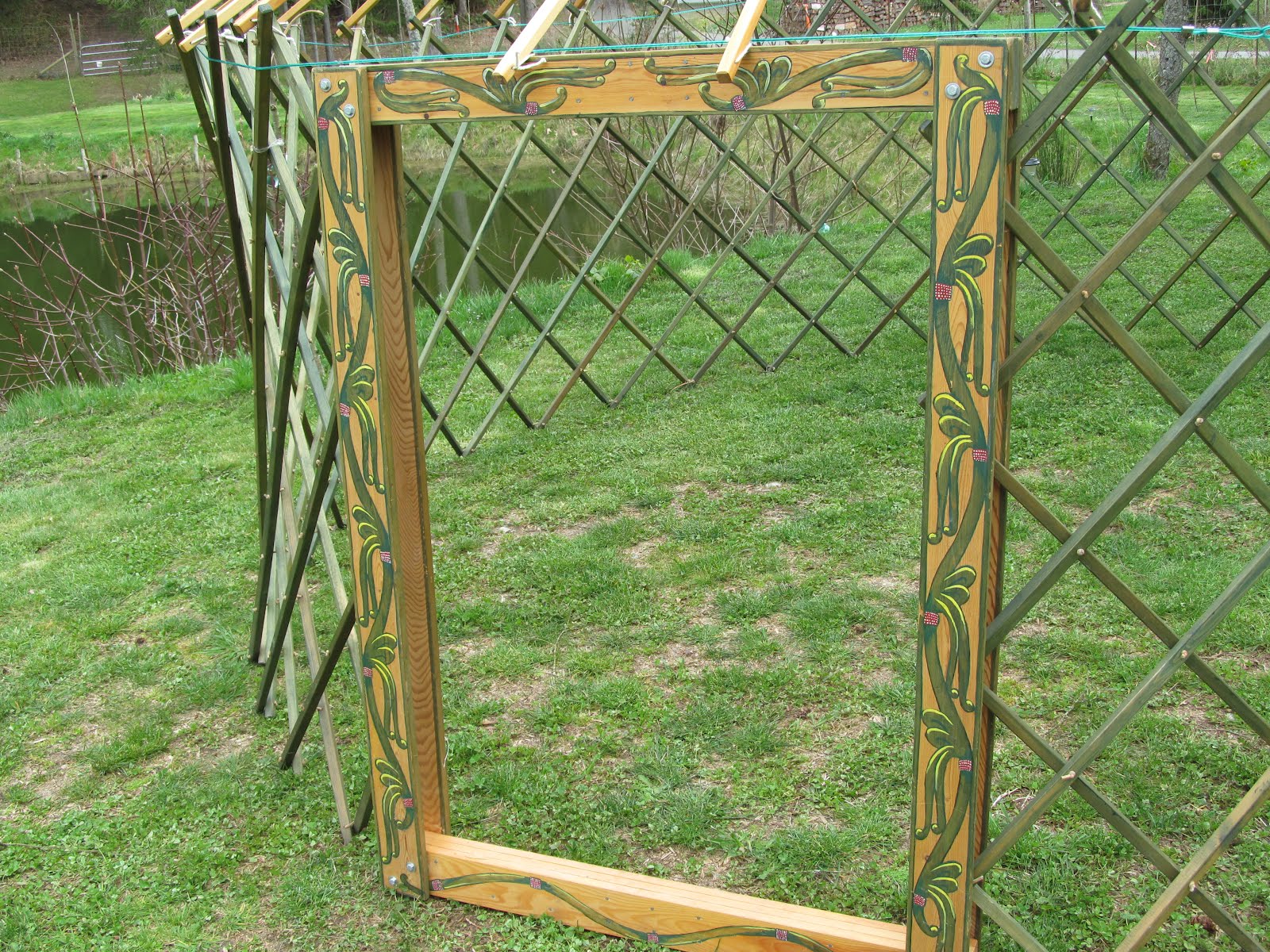
I hesitate to call this homemade because the wooden structure was made by someone with a small cottage industry of making yurts for friends. The heavy cotton canvas was sewn by the owner. It's a beautiful yurt.
The wooden walls are about 4 foot high and the centre maybe 8 or 9 feet. Excepting the door, all the joints are tied with leather cordage or cotton string. The interior of the yurt was more comfortable than the park cabin version because the natural fabric allowed the air to flow slightly through it. So it was fairly cool in the daytime, and not terribly cold at night.
The yurt was about 10 foot across, and I found it just right for temporary dwelling, but I really would want something larger if I were to stay there for any serious length of time.
The only thing I didn't like about this particular yurt was the walls didn't reach all the way to the floor, so there was a gap at the bottom that raccoons and wind could get in.

With this small amount of experience under my belt, I am convinced more than ever that I wish to live in a yurt. I have a general feel for what I want from a yurt, though I imagine that will change as I progress on this project.
I very much want the mongolian style, with felt walls and perhaps a canvas cover for winter. Natural ingredients are a must. Reclaimed and local materials are prefered. Though I don't have the skills yet, I wish to make each part myself - or at least help someone else make the parts I can't do on my own. I seek enough room for sleeping, cooking (even if it's just a fire pit), storing food, daily necessities, and if possible my spinning wheel and loom.
It's an awfully big project. I worry, an expensive one. If the beautiful mongolian yurts cost several grand, how much would it take to make my own at home? At the moment I have $20 and enthusiasm. It's not enough.
I wonder... though I hate to ask for help, I don't think I could do this alone. Maybe if I price this out, and ask the internet, maybe I could find some people with skills and spare change to help fund and assist with my dream? I know there is great kindness on the internet, but is this a worthwhile cause? What could I do to make it less selfish? What could I offer the global community?
Posting my experiences, success and failure is a start. But I would record these anyway.
What skills do I have that I can exchange? About all I'm good at is back to the land skills. Textiles, growing things, cooking in unusual situations and making full use of all ingredients. I don't like to beg, so maybe there is something I can make to say thank you to kind strangers.
These are my major obstacles: funding and finding people willing to share their time and skills to teach me how to do the bits I don't know how.
Subscribe to:
Comments (Atom)